
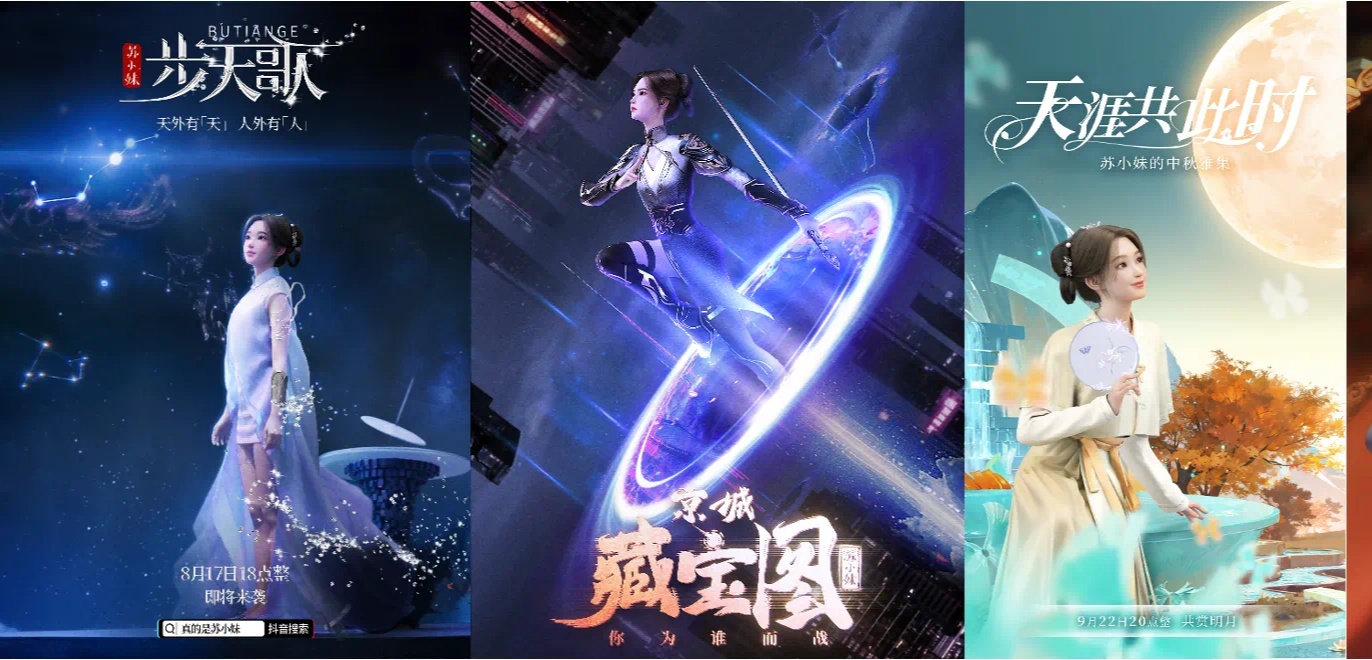
It’s over $200 million for a single play and $150,000 for a daily investment. – Dynamics are moving at an extra-imaginable rate from a “cut” form of content to the most explosive new track in the entertainment industry.
In this wave, driven by a combination of technology and demand, sharp pioneers such as the blue cursor have long been deep inside.
During the dialogue with Number 1, the blue cursor BLUE NEO department ‘ s AI-pretty group producer, Liu Shanshan, said: “We have been working on the AI video productions, starting with the AI video productions, about two years ago, and it contains both animated and authentic style.” Two years ago, the blue cursor began to explore the dynamic and fine short film, and by the beginning of this year the AI dynamic was officially the main business.

This article, No. 1, attempts to open up industry logic and future scenarios behind the dynamic wave through a line of practice represented by a blue cursor.
Narratives and Emancipation
The dynamic eruptions are essentially the result of the confluence of AI technology maturity, market thirst for new content forms and the demand for super-realistic subject matter. So what’s the difference between a live play and a live one? In Liu’s view, “In terms of content creation, AI has a much broader range of dynamic and unexplored topics than a short play.”
Unlike the traditional short play, which is limited to real actors, set-up and high cost of special effects, AI has achieved unprecedented “freedom of subject matter” in its dynamics. Whether it be Transcontinents, future science-fiction cities, or counterattacks of revenge, through rhetoric, these are things that are costly to achieve in reality and can be presented efficiently through AI-generated technology in the dynamic.
As Liu Shansan has aptly pointed out, “realism is subject to the factors of reality, while dynamic and excavated content is much broader and well suited to the construction of a big, world view.” This has led to an efficient, low-cost visualization path, with a large number of web-based and cartoons that have long been difficult to humanize because of the complexity of technology, costs or narratives.
While most of the dynamic work in the market today is based on male-frequency novels and web-based adaptations, San San Liu has revealed that the blue cursor is not limited to a single subject. “We are also trying, at the same time, to develop a female-frequency dynamic, including antiques and counterattacks. We are more concerned with content than with choice of subject matter.” To this end, the Blue Cursor works with multiple platforms, copyrighters and even short-time drama giants to jointly develop multi-purpose subject matter projects and to explore all aspects of commercialization.
It is worth noting that the dynamic “favorite” mechanism is quite different from the short play’s “strength” formula: the short play relies on a “three-second cut-in, six-second orgasm” intense rhythm, while the dynamic audience is more inclusive of the narrative rhythm, with more emphasis on the world view’s immersion and staged achievement.
Liu Shan-san shared the message: “Dynamism is better suited to build a grand view of the world, and then Seo-soo opens up the story, not so eagerly asking each episode to give a higher stimulus, but rather to gain a sense of achievement through the progressive exploration of the protagonists in the world. This type of content tends to focus more on long-term narrative lines, such as the gradual development of personality relations, the gradual upgrading of capacity systems, and the slow opening of the world’s landscape, with the attendant cumulative satisfaction of the audience.
As Liu Shanshan said, a dynamic audience ” values the logical connection, the causal relationship between events and events. This makes narratives more demanding, but also means that dynamic user stickyness and the potential for IP deposition may be stronger.
First-line production challenges
AI technology has significantly reduced dynamic production thresholds and costs, with a minimum of 1,000 to 2,500 for a minute, far below traditional animations.
The Blue Cursor internalizes the size of the different project groups according to the needs of the client, from the script to the editing of the film, with a project team of 5-8 people producing approximately 60 episodes per month. Although much more efficient than traditional animations, Liu Shanshan said, “We expect AI to be a tool to help us make a difference, although it is already much more effective than traditional animations, but what we expect it to do better.”
She noted that the most painful part of the current dynamic came from the “input of prices and capacity”. Although the AI tool has been dynamic, a large number of quantitative outputs still rely on the “stacks” model, leading to low-priced competition in the industry, and producers may choose to outsource their capacity to lower-cost, second- and third-line cities, as in the early stages of the short-run drama.
To address these challenges, the head company is actively investing in process optimization and self-study tools, and the blue cursor is autonomously developing a one-stop AI generation tool.
“BLUE NEO is now doing its own development of quantitative production tools, and so that in the future we will be able to achieve our ideas more quickly, rather than a goal with an infinite pile of manpower plants.”
Second, AI technology is not universal and there are still significant bottlenecks.
Susan Lau shared a vivid example. Last year, when the BLUE NEO project team produced Western Playbook 2.0, there was a shot of a pig who followed a Yoga girl, and the AI tool was never available, “because it was always recognized as a pervert.” At the time, the project team’s solution was quite “primitive” — putting the two characters together on a screen map and carrying the action effects separately.
According to San San Liu, “after the AI technology, this part can now be achieved directly. However, new restrictions remain. For example, the image created by AI is unstable. “A 80-episode dynamic, with only two or three types of graphics that can now stabilize a significant amount of output”; and a lack of consistency in the action of martial arts. “When we want to do a war-fighting-type dynamic, we find that AI still has some technical limitations in terms of physical and physical contact.”
While the current dynamic draught industry is still at a crude growth phase similar to the early stages of the short play, facing capacity competition and technological bottlenecks, as in the case of AI technology, it is evolving in the direction of precision, efficiency and diversity of style, as it continues to evolve over time.
Most members of Liu Shanxian’s team have a traditional visual background and are used to narratives in the field. In order to find a more dynamic narrative rhythm, the team has invested in a large number of up-front studies, in-depth analysis of the preferences of the audience on different topics, as well as in the introduction of an AI tool to assist with content summaries and rhythm combing.
This industry practice, which focuses on narrative structure and prior planning, also reflects the trend towards “quality-building” in dynamic domains. Improved content quality objectively also offers the possibility of dynamically exploring more sustainable business paths.
Dynamic business imagination.
Beyond short-term flow games, the AI dynamic is showing more imaginative and sustainable business prospects. Its core advantage is no longer limited to the flow of individual works, but lies in the long-term value operation of IP and the potential for cross-cultural communication.
While there are similarities between dynamic and short play in basic business models such as fee unlocking, advertising and so forth, the real imagination is derived from the depth of IP development and multiple derivatives.
Liu Shanxian showed the key, noting that the dynamic imagination lay in IP value development. The derivatives of a successful role IP — such as image authorization, peripheral development, cross-media adaptation — may be much higher than the flow of a single work.
“What’s the value of the IP is far greater than the income of a single film?” she explains in an example. If the dynamic role of AI is popular, the full ecological value of the IP derived from it will be very rich, and there is no risk of a real actor “falling down”. This security and durability is extremely attractive to branders and long-term content operators.
Access to the sea is another dynamic and promising direction of growth.
Unlike the cultural divides, the suitability of actors, the high cost, and the localization of the reality of human short dramas, dynamics are based on their unique “diverse properties” and have a natural global universality in artistic styles and role images, making it easier to cross geographical and cultural differences to achieve cost-effective global distribution.
As an example of the South Korean market, Liu Shan-san shared insights into localization: “We found that South Korea’s animations and strippings are largely in the form of bars. So, when it comes to the Japanese-Korean market, we have developed a set of dynamic manifestations of the vertical screen AI and enhanced the audience’s sense of introspection by adding a description.” This careful respect for the consumption habits of local users is the key to a dynamic and smooth access to overseas markets.
In addition to traditional cartoon consumer markets such as Japan and Korea, in South-East Asia, Viet Nam, Indonesia and the Portuguese- and Spanish-speaking regions of South America, users have shown a strong consumer willingness to move through content. While the whole industry is still at an exploratory stage and has yet to experience a phenomenon-grade explosion, its potential for an outbreak has been widely appreciated by capital and platforms.
Of even greater concern is the fact that major content platforms in the country are actively increasing their dynamic ecological presence. Platforms such as Daunting, Station B, Fast Trackers and others have launched specific support schemes to stimulate quality content creation through traffic-slanting, financial support and higher percentages.
Such large-scale input at the platform level not only provides unprecedented resource support to creators, but also significantly accelerates the evolution of the entire industry from small-scale production to “industrialization, quality”.
It is foreseeable that, as AI technology matures further, IP operations and sea access paths become clearer, the dynamic is expected to create a full-fledged business ecology encompassing content creation, IP derivatives, cross-media development, and global distribution.
Conclusion No. 1
The dynamic content potential was further demonstrated by the release of the comic book cooperation policy on 8 September by the quick hands, and the launch of the United Clin AI initiative.
We have become more and more aware that the dynamic is by no means just a by-product of a technological trajectory, nor should it simply be seen as an animated version of a short play, which represents a more nuanced form of content that is closer to the Z-generational aesthetics, more congenial to grand narratives, and easier to transmit across cultures.
In the future, we may see the emergence of more dynamic works with fine, unique styles and lasting IP life. Whether dynamicism can truly emerge from a sustainable path that is distinct from reality shorts and truly based on a narrative of long-term IP values and globalization still requires continuous industry exploration and practice, and the future, as we witness together.